Having a prominent forehead isn’t a flaw—it’s simply a feature that deserves the right hairstyle to complement it.
Many men struggle to find cuts that balance their facial proportions, often cycling through disappointing results that leave them feeling self-conscious.
The truth is, with the right approach to styling, texture, and length, a larger forehead can actually become an asset that frames your face beautifully.
This comprehensive guide on Big Forehead Hairstyles for Men: What Actually Looks Good will walk you through proven techniques, specific cuts, styling methods, and expert tips that actually work in real life.
You’ll discover how strategic layering, proper fringe placement, and volume manipulation can completely transform your appearance, along with practical advice on what to ask your barber and which products deliver results.
Whether you’re dealing with a receding hairline, a naturally high forehead, or simply want to create better facial balance, you’ll find actionable solutions that fit your lifestyle and hair type.
1. Understanding Your Forehead and Face Shape
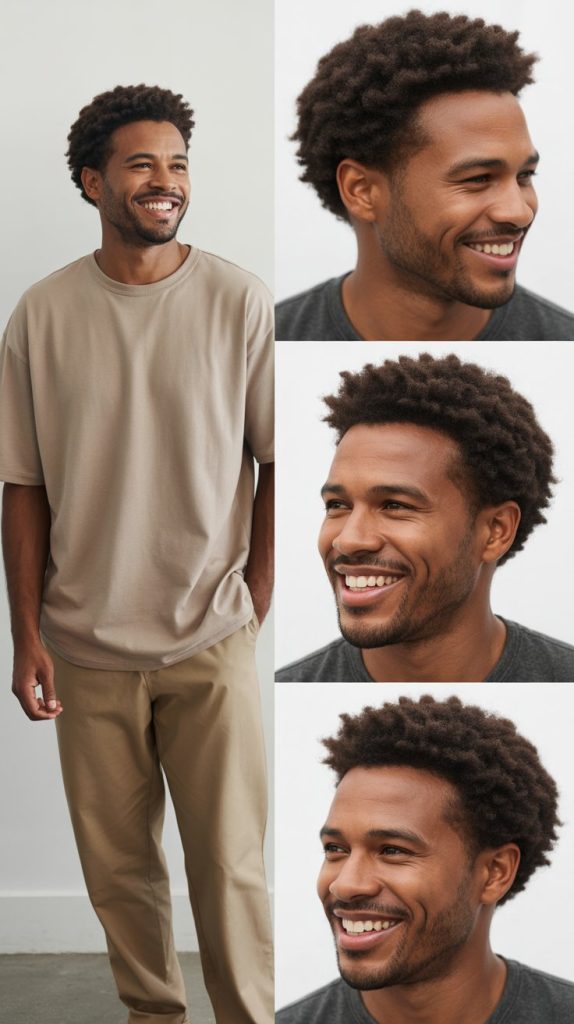
Before selecting any hairstyle, you need to understand the relationship between your forehead size and overall face shape, as this determines which cuts will genuinely flatter you.
- Your forehead is considered large if it measures more than four fingers in width when placed horizontally across it.
- Face shapes fall into categories including oval, round, square, rectangular, diamond, and heart-shaped, each requiring different styling approaches.
- A prominent forehead on an oval face needs different treatment than the same feature on a long rectangular face.
- The goal isn’t to hide your forehead completely but to create visual balance with your other facial features.
- Understanding your hairline type—whether it’s straight, widow’s peak, receding, or M-shaped—helps determine which styles will work best.
- Consider the proportion of your forehead to your chin and cheekbones when evaluating balance.
- Take front-facing photos in natural light to objectively assess your face proportions before consulting with a stylist.
2. The Fringe Strategy: When and How to Use Bangs
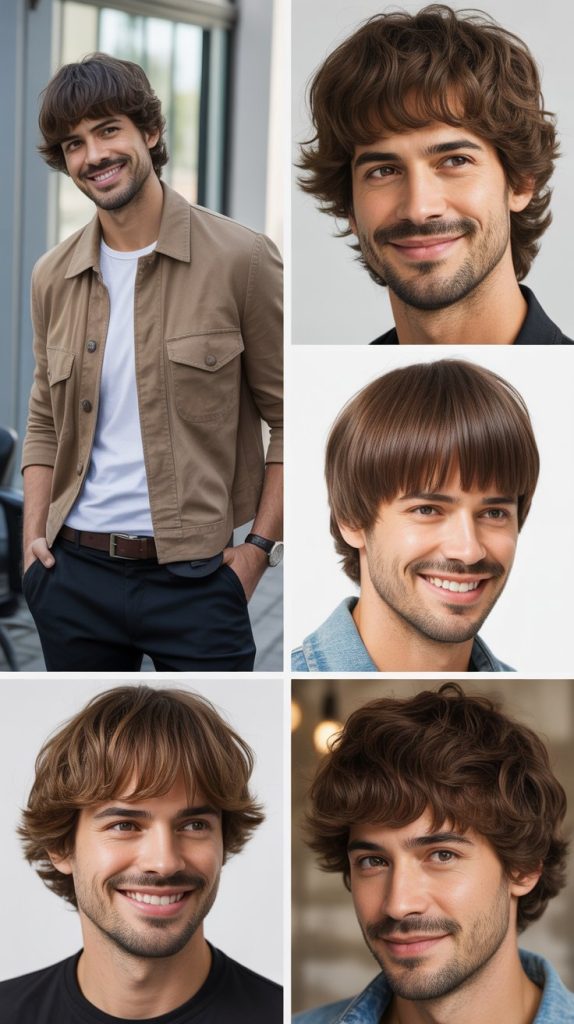
Fringes or bangs remain one of the most effective tools for managing the appearance of a larger forehead, but execution determines success or failure.
- A textured, piecey fringe creates casual coverage while maintaining a modern, effortless aesthetic.
- Side-swept bangs draw the eye diagonally across the forehead rather than emphasizing its height.
- Avoid blunt, straight-across bangs that create a harsh horizontal line and can actually emphasize forehead size.
- Curtain bangs parted in the middle offer versatility and work exceptionally well for men with widow’s peaks.
- The fringe should typically fall somewhere between your eyebrows and eyelashes for optimal coverage without looking juvenile.
- Choppy, uneven fringes add dimension and break up the forehead space more effectively than uniform lengths.
- Regular trims every 3-4 weeks keep fringes at the ideal length and prevent them from looking unkempt.
- Use a small amount of matte styling product to piece out your fringe and avoid the solid, heavy look.
3. Short Hairstyles That Create Balance
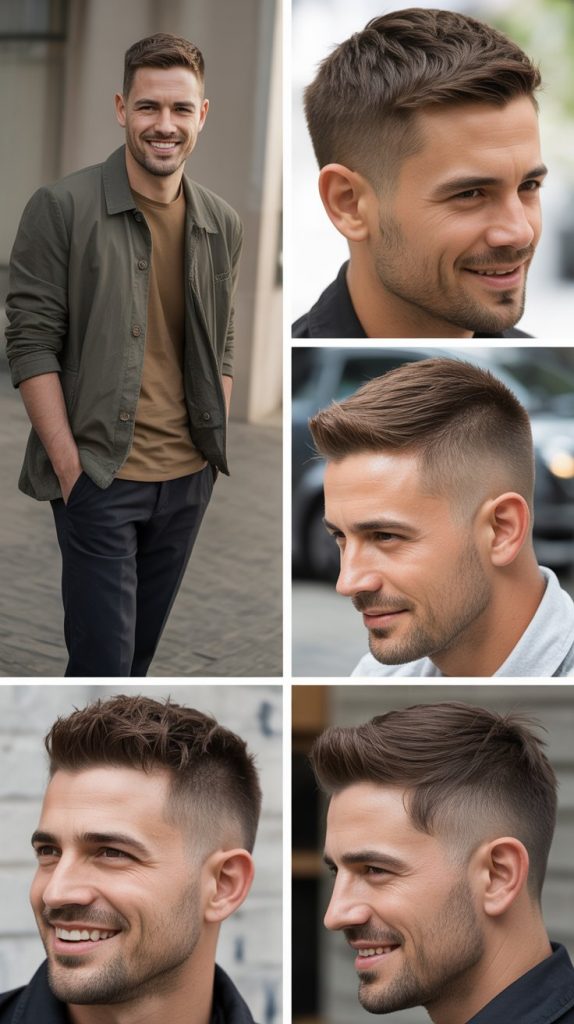
Short hairstyles can absolutely work for larger foreheads when structured correctly with the right proportions and styling techniques.
- The textured crop with a short fringe provides coverage while maintaining a clean, masculine appearance.
- A short quiff adds height on top, drawing attention upward and creating vertical rather than horizontal emphasis.
- Buzz cuts work best when paired with facial hair, which balances the exposed forehead with additional facial features.
- Short, messy styles with forward-directed texture minimize forehead appearance through strategic product application.
- Avoid extremely short cuts on the sides paired with very little length on top, as this creates a “bowling ball” effect.
- The French crop specifically works well because the short fringe naturally covers part of the forehead.
- Caesar cuts with textured, forward-brushed hair offer classic coverage that remains timeless and professional.
- Adding a light fade on the sides keeps short styles modern while the top length provides necessary coverage.
4. Medium Length Options for Maximum Versatility
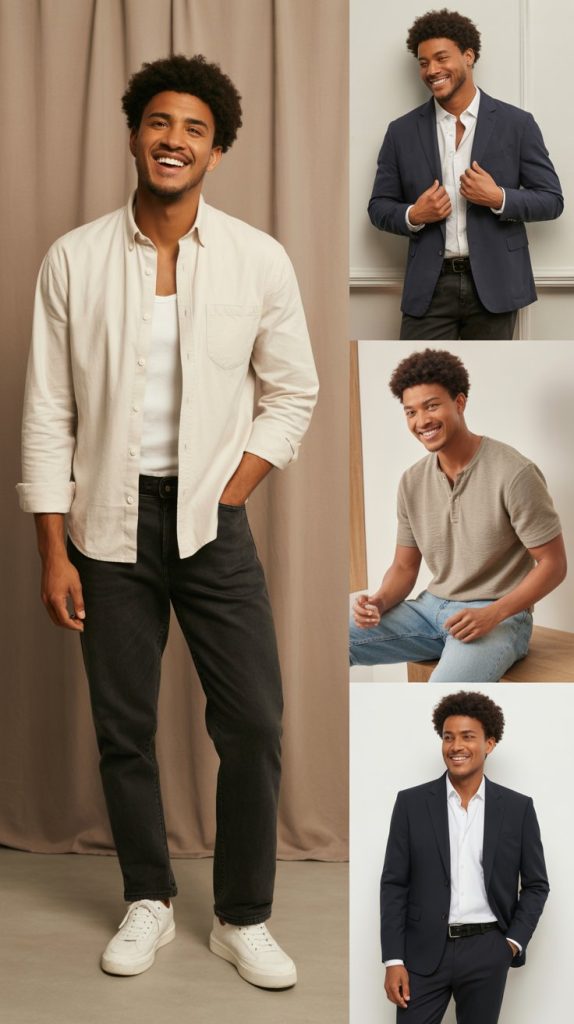
Medium-length hairstyles offer the most flexibility for styling and adjusting coverage based on your daily needs and preferences.
- A classic side part with medium length creates diagonal lines that break up the forehead’s horizontal expanse.
- Textured waves or loose curls add dimension and can be styled forward for more coverage or swept back for variation.
- Shaggy, layered cuts provide movement and natural coverage without requiring precise daily styling.
- The modern pompadour with a slight forward sweep offers height while the front portion provides strategic coverage.
- Medium-length hair allows you to experiment with different partings to find what creates the best balance for your features.
- Brushed-forward styles with texture work particularly well for casual, effortless looks that minimize forehead prominence.
- This length range typically falls between 2-5 inches on top, providing enough material to work with while remaining manageable.
- Products like sea salt spray or light styling cream enhance natural texture in medium-length styles without weighing hair down.
5. Long Hair Strategies and Styling Approaches
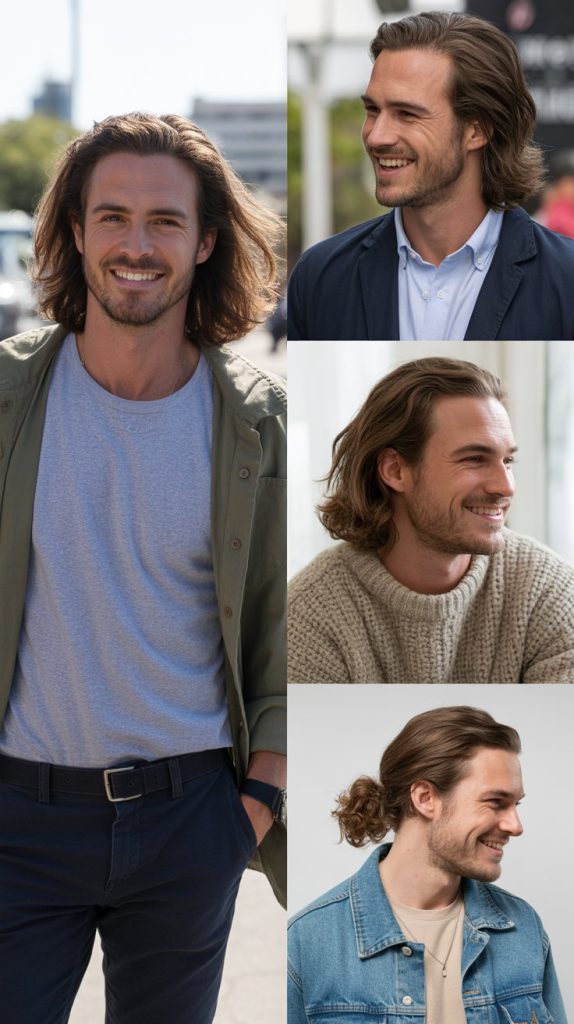
Long hair can successfully minimize forehead prominence when styled with intention rather than simply letting it grow without structure.
- Long curtain-style hair parted in the middle allows sections to fall forward, naturally framing and partially covering the forehead.
- The man bun works when you leave out face-framing pieces and a fringe rather than pulling everything back tightly.
- Shoulder-length layered cuts provide movement and dimension that draws attention away from the forehead area.
- Long hair slicked back works only if you create volume at the crown rather than pulling it flat against the scalp.
- Avoid the severe, flat look of hair pulled back tightly without any texture or volume at the hairline.
- Adding slight waves or texture to long hair prevents it from looking stringy and creates more visual interest overall.
- The surfer-style with natural, tousled texture falling forward offers relaxed coverage that doesn’t appear calculated.
- Long hair requires more maintenance and product investment but provides the most styling options day-to-day.
6. The Role of Hair Texture and Volume
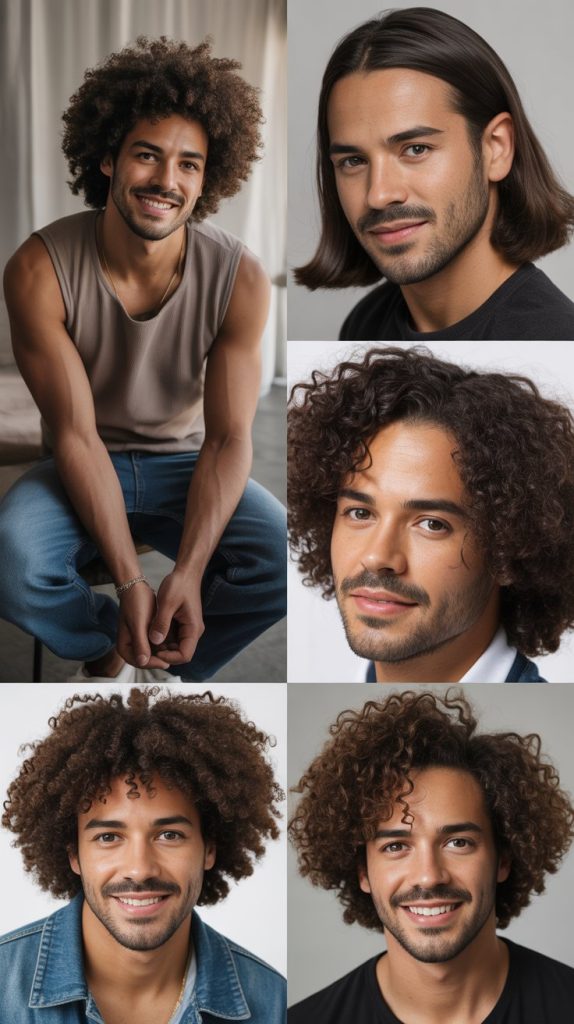
Your natural hair texture significantly impacts which styles work best, and understanding how to enhance or modify it creates better results.
| Hair Texture | Best Styles | Styling Approach | Product Recommendations |
|---|---|---|---|
| Straight | Textured crops, side-swept styles, structured fringes | Add texture with product and blow-drying techniques | Matte paste, sea salt spray, texturizing powder |
| Wavy | Natural flow styles, messy looks, side parts | Enhance natural wave pattern, use lightweight products | Curl cream, mousse, light hold gel |
| Curly | Longer styles with natural volume, defined curls forward | Define curls, maintain moisture, avoid flattening | Leave-in conditioner, curl defining cream, oil |
| Coarse/Thick | Bold volume styles, structured cuts, textured quiffs | Use strong-hold products, embrace natural body | Strong-hold pomade, clay, firm gel |
- Fine, straight hair requires texturizing products to create the illusion of fuller, more dimensional coverage.
- Naturally wavy or curly hair provides built-in volume and texture that can be directed forward for forehead coverage.
- Thick, coarse hair holds styles better but may require thinning or layering to prevent excessive bulk.
- Creating volume at the crown and front hairline draws the eye upward rather than emphasizing forehead width.
- Blow-drying techniques make enormous differences—directing airflow forward while lifting at the roots creates strategic coverage.
- Avoid flat, lifeless hair that lies against the scalp, as this emphasizes rather than balances a prominent forehead.
- Regular deep conditioning maintains hair health, making it more responsive to styling and better at holding shape throughout the day.
7. Strategic Hairline Management and Recession Considerations
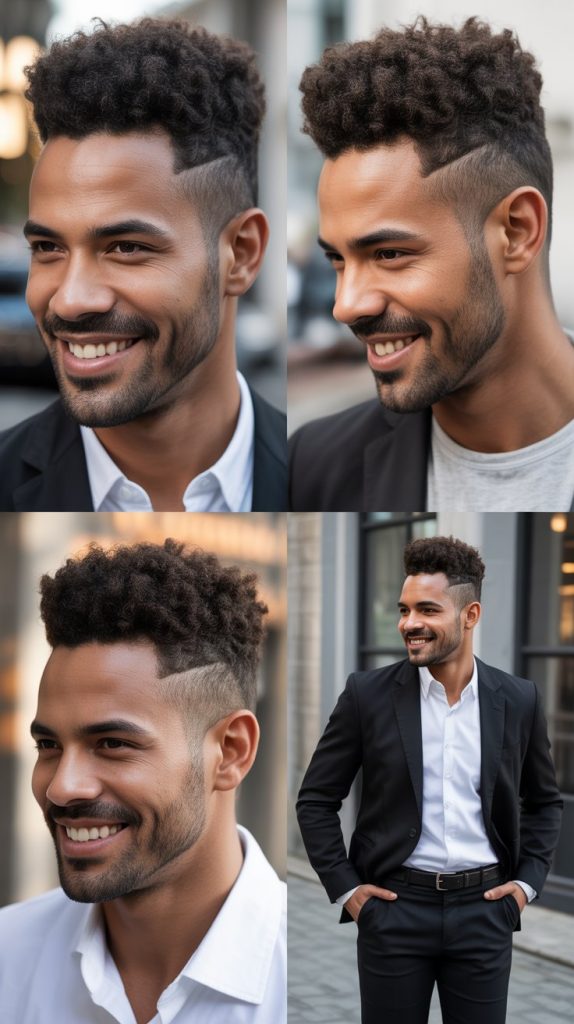
Many men with prominent foreheads also deal with receding hairlines, requiring specific approaches that address both concerns simultaneously.
- Temple fades strategically trim the sides very short where recession is most visible while maintaining length on top for coverage.
- Avoid hairstyles that expose a receding hairline completely, such as slicked-back looks without any forward elements.
- Creating volume and forward movement at the crown helps compensate for thinning at the temples or hairline.
- The modern comb-over, when done subtly with texture rather than harsh lines, provides coverage while looking contemporary.
- Accepting some forehead visibility while strategically styling the remaining hair creates more natural results than aggressive hiding attempts.
- Microfiber products can temporarily fill in thinning areas and create the appearance of denser hair at the hairline.
- Consult with dermatologists about treatments like minoxidil or finasteride if hairline recession concerns you significantly.
- A well-maintained beard draws attention to the lower face and creates better overall balance when dealing with both concerns.
8. The Beard Balance Technique
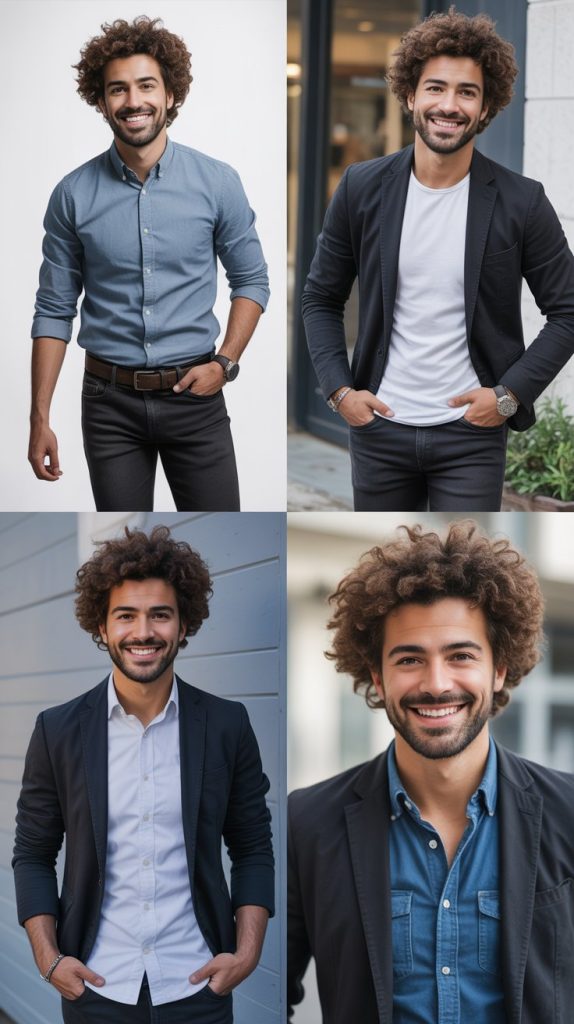
Facial hair strategically alters your face’s visual proportions, making it one of the most effective tools for balancing a prominent forehead.
- A full, well-groomed beard adds length to the lower face, creating better proportion with a larger forehead.
- Even stubble or light scruff adds definition to the jawline and draws attention downward from the forehead area.
- The extended goatee or Van Dyke style creates vertical lines that balance horizontal forehead width.
- Avoid chin straps or styles that emphasize the jaw width without adding vertical length to balance your upper face.
- Keeping beard edges clean and well-defined prevents a sloppy appearance while maintaining the balancing effect.
- The density and length of your beard should correlate with your forehead size—more prominent foreheads benefit from fuller beards.
- Mustaches alone rarely provide sufficient balance, but when combined with other facial hair, they add to the overall effect.
- Regular beard maintenance including trimming, oiling, and shaping ensures it serves its balancing purpose effectively.
9. What to Tell Your Barber or Stylist
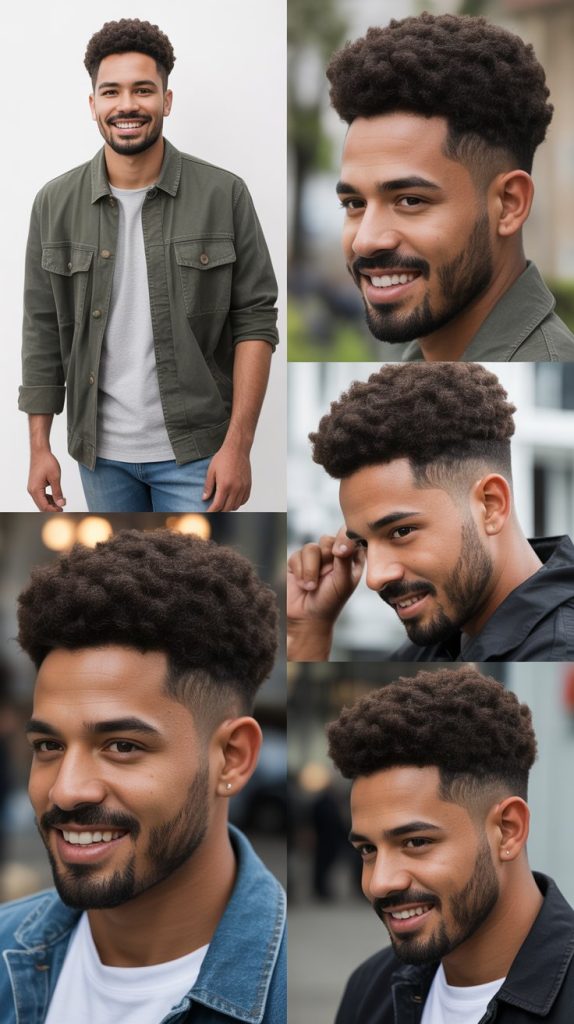
Communication with your hair professional determines whether you get the look you envision or leave disappointed with poor results.
- Bring multiple reference photos showing different angles of styles you like rather than describing verbally what you want.
- Explicitly mention that you want to create balance for a larger forehead rather than expecting them to notice and address it independently.
- Ask about their experience with cutting hair to complement prominent foreheads and which specific techniques they’d recommend.
- Request a longer initial cut so you can test the style and length before committing to something very short.
- Discuss how the style will look when growing out and how frequently you’ll need maintenance cuts.
- Be honest about your styling routine—if you won’t spend 15 minutes daily styling, choose something low-maintenance.
- Ask them to teach you their styling technique during the appointment so you can replicate it at home.
- Inquire about specific product recommendations they have in stock rather than generic suggestions you’ll struggle to find later.
- Build a relationship with one skilled professional rather than visiting different barbers constantly, as they’ll learn your hair and preferences.
10. Essential Styling Products and Tools

The right products and tools transform a mediocre cut into a great-looking style while making daily maintenance faster and more effective.
- Matte clay or paste provides hold and texture without shine, creating natural-looking styles with forward movement.
- A quality blow dryer with concentrator nozzle allows precise direction of hair and volume creation at the roots.
- Sea salt spray adds texture and slight hold to fine or straight hair that naturally lacks body and dimension.
- Round brushes in various sizes help create volume when blow-drying, particularly effective for quiffs and forward-swept styles.
- Texturizing powder applied at the roots creates lift and volume that lasts throughout the day without looking heavy.
- Light-hold hairspray as a finishing product maintains your style without creating stiffness or an unnatural appearance.
- Pre-styling products like heat protectant and volumizing mousse prepare hair for heat styling while preventing damage.
- Wide-toothed combs distribute product evenly through damp hair without breaking or damaging it during the styling process.
- Investing in professional-grade products rather than drugstore alternatives typically provides better results and requires less product per application.
11. Daily Styling Routine and Maintenance Tips

Consistent daily habits determine whether your hairstyle successfully minimizes your forehead or falls flat by midday due to poor maintenance.
- Wash your hair 3-4 times weekly rather than daily to maintain natural oils that provide texture and hold.
- Towel-dry hair to about 80% dry before applying any styling products for optimal absorption and distribution.
- Apply product to damp hair, working it through evenly from roots to ends with your fingers or a wide-toothed comb.
- Blow-dry in the direction you want your hair to fall, using your hands or a brush to guide and shape it.
- Focus heat and volume at the front hairline area where you need the most coverage and lift.
- Allow hair to cool completely in its styled position before touching it again to ensure the style sets properly.
- Use minimal finishing product—a small amount of matte paste or powder to separate pieces and add final texture.
- Refresh your style midday if needed with dry shampoo or texturizing spray rather than rewashing and restyling completely.
- Sleep on a silk or satin pillowcase to reduce friction that flattens your style and causes bedhead in the morning.
12. Common Mistakes to Avoid
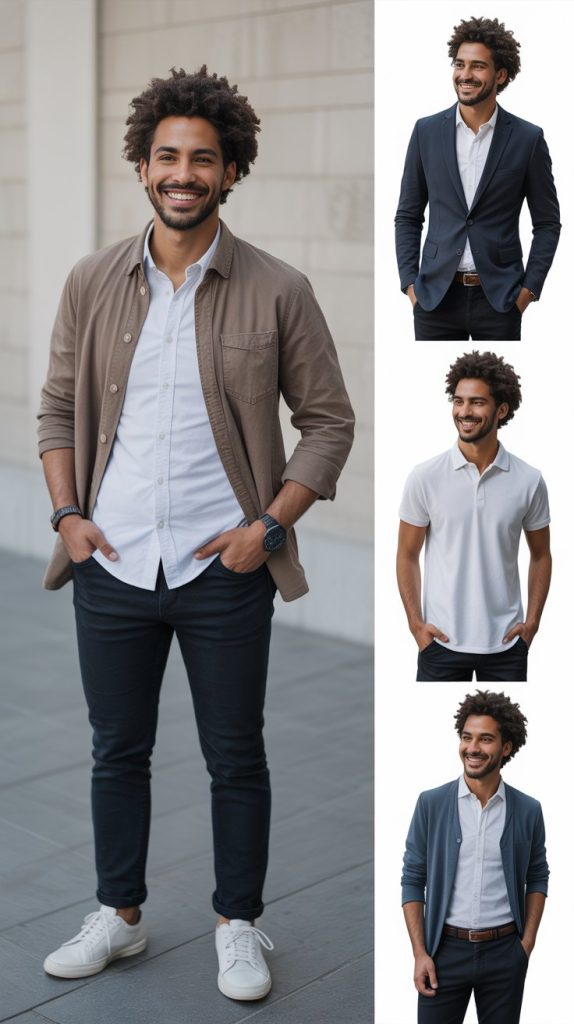
Understanding what doesn’t work prevents wasted time, money, and frustration while pursuing hairstyles that actually flatter your features.
- Slicking hair completely back without any forward elements or volume exposes your entire forehead and often makes it appear larger.
- Choosing extremely short cuts without adequate facial hair to balance the exposed forehead creates an unbalanced appearance.
- Using too much product creates a heavy, greasy look that weighs hair down and eliminates the volume you need.
- Getting hairstyles that require extensive daily maintenance when your lifestyle doesn’t accommodate that commitment leads to disappointment.
- Ignoring your natural hair texture and fighting against it rather than working with it creates frustration and poor results.
- Copying celebrity hairstyles without considering whether your hair type, face shape, and features match theirs sets unrealistic expectations.
- Cutting your own fringe or bangs at home without professional guidance typically results in uneven, unflattering coverage.
- Waiting too long between cuts allows your style to lose its shape and effectiveness, particularly with shorter styles requiring frequent maintenance.
- Failing to adjust your style for different seasons and weather conditions leads to styles that fall apart in humidity or winter dryness.
Successfully styling a prominent forehead comes down to understanding your unique features and selecting approaches that create balance rather than attempting to hide what makes you distinctive.
The strategies outlined in Big Forehead Hairstyles for Men: What Actually Looks Good provide you with proven techniques ranging from strategic fringe placement to beard balancing, texture manipulation, and proper product usage.
Remember that the goal isn’t perfection or completely concealing your forehead, but rather creating harmonious proportions that highlight your best features while minimizing concerns.
Experiment with different lengths, textures, and styling approaches to discover what feels authentic to your personal style and fits your daily routine.
Invest in a skilled barber who understands facial proportions, quality products that deliver consistent results, and the patience to refine your technique over time.
Your forehead is simply one feature among many, and with the right hairstyle, it becomes a balanced part of an overall confident, well-groomed appearance that reflects who you are.
