Having a prominent forehead doesn’t mean you’re limited in your hairstyle choices—in fact, it opens up opportunities to experiment with cuts and styles that create perfect balance and proportion.
Many men worry unnecessarily about their forehead size, not realizing that with the right techniques, they can transform what they perceive as a challenge into a distinctive feature that enhances their overall appearance.
This comprehensive guide on How to Style Hair with a Big Forehead for Men: 9 Easy Tricks will walk you through proven methods that professional stylists use to create flattering looks, from strategic fringe placement to texture manipulation and everything in between.
Whether you prefer classic cuts or modern trends, you’ll discover practical solutions that work with your natural hair type and face shape, giving you the confidence to style your hair with purpose and precision.
1. Master the Strategic Fringe Technique

The strategic fringe is your most powerful tool when learning how to minimize forehead prominence while maintaining a stylish, masculine appearance.
A well-placed fringe creates an instant visual break that draws attention to your eyes and overall facial features rather than the forehead area.
Types of Fringes That Work Best:
| Fringe Style | Best For | Maintenance Level |
|---|---|---|
| Textured Fringe | Thick, wavy hair | Medium |
| Side-Swept Fringe | All hair types | Low |
| Choppy Fringe | Fine to medium hair | Medium |
| Curtain Fringe | Straight to wavy hair | Low to Medium |
Application Tips:
- Ask your barber to cut your fringe at eyebrow level or slightly below for optimal coverage without looking dated.
- Use a light styling cream or pomade to add definition and prevent the fringe from looking too heavy or greasy.
- Blow-dry your fringe forward and slightly to one side to create natural movement and avoid a harsh, straight-across look.
- Keep the sides shorter (typically a fade or taper) to create contrast and make the fringe appear more intentional rather than like you’re hiding something.
- Schedule trims every 3-4 weeks specifically for the fringe area to maintain the perfect length and shape.
According to professional hair stylists at the American Board of Certified Hair Colorists, the key to a successful fringe is ensuring it complements your face shape rather than simply covering your forehead completely.
2. Utilize the Side Part Power Move

The side part is a timeless technique that creates asymmetry and draws the eye away from the forehead’s center, making it appear less prominent.
This classic styling method works exceptionally well for professional environments while still offering versatility for casual settings.
Creating the Perfect Side Part:
- Locate your natural part by combing your hair forward when wet and observing where it naturally wants to separate.
- Position your part approximately one inch from your temple for the most flattering proportions on larger foreheads.
- Use a fine-toothed comb to create a crisp, clean line that looks intentional and polished.
- Apply a medium-hold pomade or styling cream while hair is slightly damp to lock the part in place throughout the day.
- Blow-dry the hair on the heavier side forward and across to maximize coverage of the forehead area.
Styling Variations:
- Classic Side Part: Keep both sides neat and combed, with more volume on the heavier side for a traditional, professional appearance.
- Modern Textured Side Part: Add texture using sea salt spray or matte clay for a more contemporary, relaxed version.
- Disconnected Side Part: Combine with an undercut or fade on the sides for an edgy, fashion-forward interpretation.
- Slicked Side Part: Use high-shine pomade for formal occasions or when you want a more dramatic, vintage-inspired look.
3. Embrace the Textured Crop Revolution
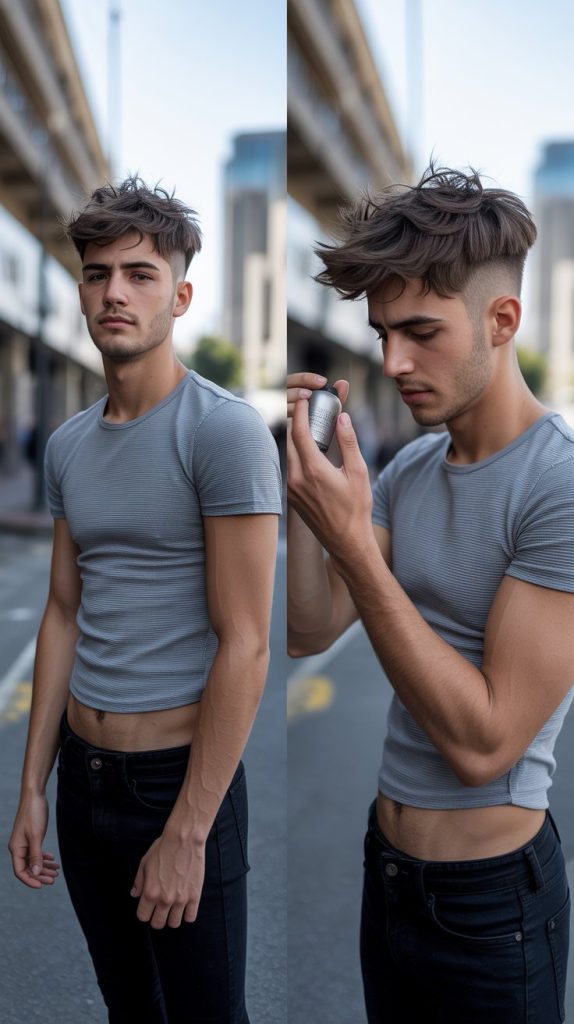
The textured crop has become one of the most popular modern hairstyles for men with larger foreheads because it creates visual interest on top while maintaining clean, short sides.
This style uses deliberate texture and strategic length to balance facial proportions naturally.
Why the Textured Crop Works:
- The choppy, piece-y texture on top breaks up the horizontal line between your hairline and forehead.
- Short sides create a strong vertical emphasis that elongates the face and minimizes forehead width.
- The forward-directed styling naturally covers more of the forehead without appearing obvious.
- This cut requires minimal daily maintenance while still looking intentionally styled.
Styling Your Textured Crop:
- Start with towel-dried hair that still retains some moisture for easier product distribution.
- Use a matte clay or texture paste (about a dime-sized amount) and warm it between your palms thoroughly.
- Work the product through your hair from back to front, lifting at the roots for added volume.
- Use your fingers to create separation and piece out individual sections for that signature textured appearance.
- Finish by directing some of the front pieces forward and slightly downward to softly frame your forehead.
The International Association of Trichologists notes that textured styles work particularly well because they create the illusion of more hair density, which naturally balances larger forehead areas.
4. Deploy the Quiff Strategy

The quiff combines height with forward movement, creating a powerful optical illusion that reduces the perceived size of your forehead.
This versatile style can be adapted for both casual and formal occasions, making it an excellent all-purpose option.
Building the Perfect Quiff:
- Begin with damp hair and apply a volumizing mousse or heat protectant spray from roots to ends.
- Use a round brush or paddle brush while blow-drying to direct hair upward from the roots and forward at the tips.
- Create maximum height at the front by lifting the hair perpendicular to your head during the drying process.
- Once dry, apply a strong-hold pomade or wax to the front section to lock in the shape.
- Slightly push the front portion forward so the quiff angles over the forehead rather than straight up.
Quiff Variations for Different Settings:
- Business Quiff: Keep it moderate in height (2-3 inches) with a sleek finish using high-shine pomade.
- Casual Quiff: Add more texture and height (3-4 inches) with a matte product for weekend wear.
- Messy Quiff: Incorporate irregular texture and less structure for a relaxed, artistic appearance.
- Undercut Quiff: Pair with dramatically short or shaved sides for maximum contrast and modern edge.
5. Work the Angular Fringe Method

The angular fringe differs from a straight-across fringe by creating diagonal lines that add dimension and sophistication while strategically covering the forehead.
This technique is particularly effective for men who want coverage without the commitment of a full fringe.
Creating Angular Interest:
- Request that your barber cut the front section longer on one side, creating a deliberate diagonal line from one temple to the other.
- The longer side should extend to approximately mid-eyebrow level, while the shorter side sits just at the beginning of the eyebrow.
- Style the fringe to sweep across the forehead rather than hanging straight down for maximum coverage and visual movement.
- Use a flat iron or straightener on low heat to enhance the sleek, angular quality if you have wavy or curly hair.
- Apply a light-hold spray or serum to maintain the angle throughout the day without stiffness.
Benefits of the Angular Approach:
- Creates sophisticated asymmetry that naturally guides the viewer’s eye across the face rather than focusing on the forehead.
- Offers more styling flexibility than a straight fringe, allowing you to switch the direction based on your mood or outfit.
- Works exceptionally well with oval, square, and diamond face shapes by adding complementary angles.
- Appears more modern and fashion-forward than traditional fringe styles, making it suitable for creative professionals.
6. Maximize the Messy Forward Sweep
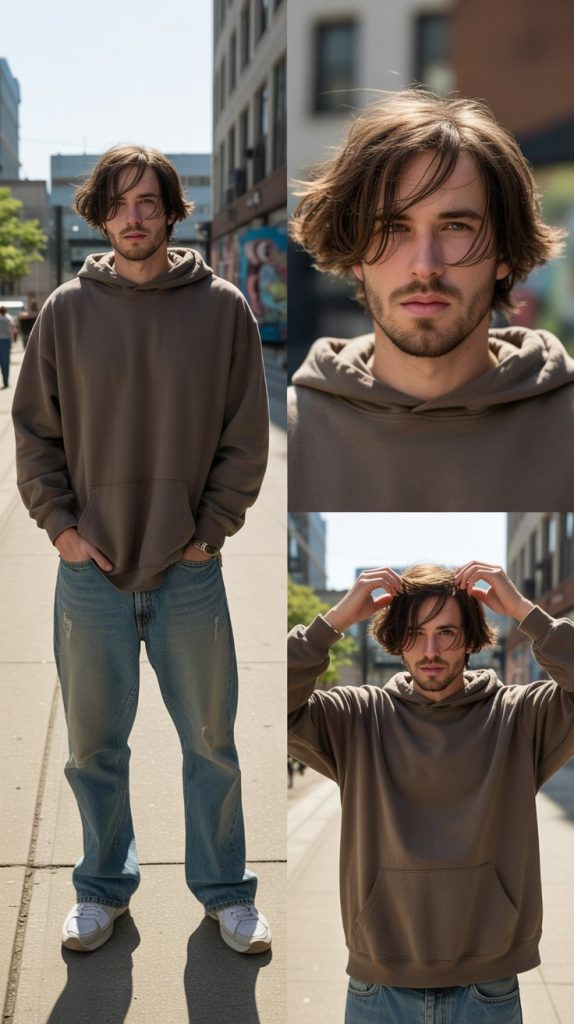
The messy forward sweep combines controlled chaos with strategic direction, creating a casual, confident look that naturally minimizes forehead visibility.
This approach works particularly well for men with naturally wavy or thick hair.
Achieving the Effortless Sweep:
- Start with hair that’s 3-5 inches on top to ensure enough length for proper forward movement and volume.
- Apply a sea salt spray or texturizing spray to damp hair to enhance natural wave and create grip.
- Blow-dry while using your fingers (not a brush) to direct hair forward and create natural-looking irregularity.
- Once mostly dry, work a small amount of matte clay or paste through the top section.
- Push and sweep the hair forward toward your forehead, creating peaks and valleys rather than a uniform surface.
Maintenance and Daily Styling:
- This style works best with second-day hair that has some natural texture and oil buildup.
- Refresh in the morning by misting with water and scrunching with your hands to reactivate the product.
- Avoid over-washing; shampooing 2-3 times per week maintains the texture needed for this style.
- Trim every 6-8 weeks to prevent the look from becoming too shaggy or losing its intentional shape.
7. Leverage the Faux Hawk Technique

The faux hawk creates a central ridge of height that draws attention upward and away from the forehead while maintaining professional acceptability.
Unlike a traditional mohawk, this version keeps hair on the sides while still creating dramatic vertical emphasis.
Constructing Your Faux Hawk:
- Request tapered or faded sides (typically a #2 to #4 clipper guard) with 3-4 inches of length maintained through the center strip from front to back.
- When styling, apply a strong-hold gel or pomade to damp hair, focusing on the central section.
- Use your fingers or a comb to push hair from both sides toward the center, creating a vertical ridge.
- Angle the front portion slightly forward so it crests over the forehead area rather than pointing straight up.
- Set with a strong-hold hairspray to maintain the structure throughout the day.
Professional vs. Casual Versions:
| Aspect | Professional Faux Hawk | Casual Faux Hawk |
|---|---|---|
| Height | 1-2 inches | 2-4 inches |
| Sides | Subtle taper or fade | High fade or undercut |
| Product | Medium-hold pomade | Strong-hold gel |
| Finish | Sleek and controlled | Textured and spiky |
According to hair trend analysts at Matrix Professional, the faux hawk remains popular because it offers edge and personality while still being workplace-appropriate when styled conservatively.
8. Implement the Layered Volume Approach

Layered volume creates depth and dimension that naturally balances a larger forehead by adding visual weight to the hair itself.
This technique works through strategic cutting and styling that maximizes fullness without adding excessive length.
Creating Effective Layers:
- Work with a skilled stylist who can create graduated layers that are longer on top (3-4 inches) and progressively shorter moving down.
- Request point-cutting or texturizing techniques that remove bulk while adding movement and preventing heavy, flat hair.
- The layers should start relatively high on the head to create lift at the crown and temples.
- Ensure the front layers are cut to fall just at or slightly below the eyebrow line for optimal forehead coverage.
Styling for Maximum Volume:
- Apply a volumizing mousse to the roots when hair is damp, focusing on the crown and top sections.
- Blow-dry with a large round brush, rolling the brush backward and upward to create lift at the roots.
- Once completely dry, flip your head upside down and blast with cool air to set the volume.
- Use your fingers to lightly tousle the layers and create natural-looking separation.
- Finish with a light misting of flexible-hold hairspray to maintain volume without stiffness.
Best Hair Types for Layered Volume:
- Fine Hair: Benefits most from layering as it creates the illusion of thickness and fullness.
- Medium Hair: Easily holds volume and shape without requiring excessive product.
- Thick Hair: Layers remove weight and prevent the mushroom effect while still maintaining fullness.
- Wavy Hair: Natural texture enhances the layered look and requires minimal styling effort.
9. Master the Grown-Out Fade Combination

The grown-out fade combines the structure of a fresh fade with the softness of grown-out top length, creating a balanced look that strategically minimizes forehead prominence through contrast and proportion.
This style offers versatility as it transitions through different lengths.
Understanding the Grown-Out Fade:
- The sides feature a gradual fade (low, mid, or high depending on preference) that’s maintained every 2-3 weeks.
- The top section is allowed to grow to 4-6 inches, creating significant length contrast with the sides.
- This length differential creates strong vertical lines that minimize horizontal forehead width.
- The longer top provides multiple styling options—slicked back, textured forward, or swept to the side.
Styling Options Through Growth Stages:
- Weeks 1-2: Fresh fade with shorter top—style with light pomade pushed forward for subtle forehead coverage.
- Weeks 3-4: Fade growing in, top gaining length—add texture with clay and create more pronounced forward movement.
- Weeks 5-6: Softer fade, longer top—experiment with side parts, quiffs, or messy textured styles that maximize the length advantage.
- Week 7+: Refresh the fade while maintaining top length to restart the cycle with a polished look.
Product Recommendations by Style Goal:
- Textured Forward Look: Matte clay or fiber paste for separation and hold without shine.
- Sleek Side Part: Medium to high-shine pomade for classic polish and control.
- Messy Volume: Sea salt spray combined with light paste for natural, beach-inspired texture.
- Slicked Back: Strong-hold gel or heavy pomade for all-day structure and dramatic effect.
Research from the Professional Beauty Association indicates that fades remain the most requested men’s haircut globally because they offer clean, masculine lines that work with virtually any top styling choice.
Conclusion
Mastering How to Style Hair with a Big Forehead for Men: 9 Easy Tricks empowers you to transform your grooming routine from a source of concern into an opportunity for creative self-expression and enhanced confidence.
Each technique presented—from strategic fringes and side parts to textured crops and volumizing layers—offers practical solutions that work with your natural features rather than fighting against them, creating balanced proportions that highlight your best attributes.
The key to success lies in choosing styles that complement your face shape, hair type, and lifestyle while working with a skilled barber who understands the nuances of creating flattering looks for prominent foreheads.
Remember that consistency in maintenance, quality products, and proper styling techniques make the difference between a haircut that simply covers your forehead and one that genuinely enhances your overall appearance.
By implementing these professional strategies and adapting them to your personal style, you’ll discover that a larger forehead isn’t a limitation but rather a distinctive feature that, when styled correctly, contributes to a memorable and attractive look that commands attention for all the right reasons.
